How Mental Health AI Is Making Therapy Feel Less Out of Reach
Author: /
Released:December 3, 2025
Think you need a $200-an-hour specialist just to manage daily stress? You’re likely overpaying. While traditional therapy remains vital for crisis care, a new wave of mental health AI is handling the "heavy lifting" of daily wellness for a fraction of the cost—and most people are missing out.
Why Traditional Care is Failing Your Wallet
The math of modern mental health is brutal. Between high deductibles and the "waitlist wasteland," many people give up before their first session. This is where ai for health and wellbeing steps in, acting as a high-speed bridge between doing nothing and full clinical intervention.
In 2026, the shift isn't just about technology; it’s about accessibility. For the price of a single fancy coffee, users are now accessing 24/7 support that used to require a medical degree to administer. This isn't a replacement—it's a massive, cost-effective upgrade to your mental toolkit.

Why "Mental Health AI" is the Smartest Investment
When people search for ai mental health solutions, they aren't looking for a textbook. They want to know: Can this stop my spiraling thoughts at 3 AM? The answer is increasingly "Yes." These tools use Large Language Models (LLMs) to provide Evidence-Based Practice (EBP) techniques like CBT instantly. [1]
By automating the "boring" parts of wellness—tracking moods, identifying triggers, and practicing breathing exercises—these platforms save the "expensive human hours" for when you truly need them. It is a strategic reallocation of your personal wellness budget that maximizes ROI on your sanity.
The 3 Categories of AI Tools You Actually Need
Not all AI is created equal. To avoid "app fatigue," you need to match the tool to your specific mental state. Here is the breakdown of the current market leaders and how they actually function in a real-world setting.
1. The "Logic Fixers" (CBT & DBT Bots)
These are the heavy hitters for anxiety and depression management. Tools like Woebot or Wysa don't just "chat"; they guide you through Cognitive Behavioral Therapy (CBT) frameworks.
Best for: People who feel "stuck" in negative thought patterns.
The Win: They provide clinical-grade exercises without the clinical-grade bill.
2. The "Empathy Engines" (AI Companions)
Sometimes you don't want a lesson; you just want to be heard. Replika and similar platforms offer a high degree of personalization, creating a digital "friend" that learns your history and preferences.
Best for: Loneliness and social anxiety practice.
The Win: Zero judgment and 100% availability. It’s the ultimate "safety net" for venting.
3. The "Silent Monitors" (Wellness Tracking)
This is the ai for health and wellbeing that works in the background. Apps like Daylio or integrated features in Apple Health use data patterns to predict when you’re heading for a burnout.
Best for: High-performers who ignore their own stress signals.
The Win: Prevents "mental crashes" by flagging issues days before they become crises.
AI vs. Human Therapy: The Brutal Cost Comparison
If you are trying to decide where to put your money, look at the 12-month cost projection. The difference is staggering, and for many, the "AI-first" approach is the only sustainable way to stay consistent with self-care.
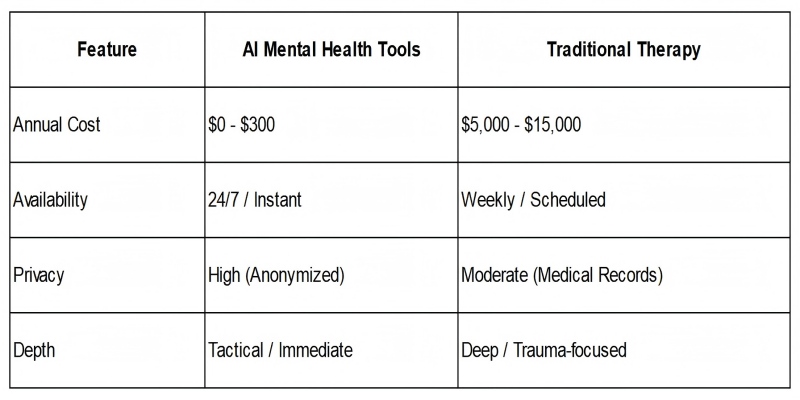
The Strategy: Use AI for the 90% of your daily "maintenance" and save your cash for a high-end human specialist for the 10% of deep-seated issues. This hybrid model is how the most "well" people are operating in 2026.
Reality Check: When to Ditch the AI
While mental health ai is a breakthrough, it isn't magic. There are "Red Zones" where relying on an app is a dangerous mistake. Smart users know the boundary lines to stay safe and get the best results.
If you are dealing with severe trauma, active suicidal ideation, or complex disorders like Schizophrenia, AI is currently out of its league. These tools are "co-pilots," not "pilots." [2] If an app claims it can "cure" a clinical diagnosis without human oversight, that is a red flag to walk away.
Furthermore, "AI fatigue" is real. If you find yourself "ghosting" your chatbot, it’s likely because you lack the social accountability that a human therapist provides. Use the AI to build habits, but don't expect it to replace the power of being truly seen by another person.
How to Choose Without Getting Scammed
Before you input your credit card, run every ai mental health app through this 3-point "Value Filter":
- Data Sovereignty: Does the app let you delete your data? If they don't explicitly mention HIPAA-ready standards or end-to-end encryption, your "secrets" might be their next training set.
- Evidence Base: Does the app cite actual psychological studies? Look for "CBT-based" or "Peer-reviewed" in their documentation.
- The "Check-in" Test: Does the tool proactively reach out to you, or is it just sitting there? The best ai for health and wellbeing is proactive, not reactive.

The Verdict: Your Wallet and Your Mind Will Thank You
The era of "all-or-nothing" mental healthcare is over. You no longer have to choose between "suffering in silence" and "going broke for therapy." By leveraging the current state of mental health ai, you can build a resilient mind on a budget that actually makes sense.
The most successful users are those who treat AI as a daily "mental gym"—a place to flex your coping muscles so you’re ready for whatever life throws at you. The tools are ready, the costs have plummeted, and the barriers to entry have vanished.
Whether you're looking for a 24/7 sounding board or a data-driven way to track your happiness, the current landscape of AI health tools offers a level of personalized care that was unimaginable just three years ago. It’s worth exploring the options, comparing the features, and seeing which digital partner fits your lifestyle.
References
[1] AI in Mental Health: Opportunities and Challenges
[2] The Ethics of AI in Mental Health
[3] World Health Organization: Digital Health